



Most articles about buying followers are written for creators and personal accounts. Brands have a different set of questions. Does it actually convert? Does it look unprofessional if anyone finds out? What is the real business impact, beyond the vanity number on the profile? Is there a version of this that makes sense for a serious company, or is it strictly a creator economy hack?
I have spent enough time around marketing teams that have actually tried this to give you the honest answer, with the math worked out where the math is worth working out.
This is for the founders, marketers, and growth leads who are tired of B2B advice that pretends X does not matter. It does. Your follower count on a company X account is one of the most consequential first impression signals you have, and ignoring it because the strategy feels weird is leaving free social proof on the table.
The Short Answer
For most B2B and DTC businesses, buying followers for your company X account is a high ROI move when done correctly. The cost is low (typically a few hundred dollars), the impact compounds for the lifetime of the account, and the risk to the business is essentially zero if you use a real follower service rather than a bot operation.
The version that does not work is the one most people imagine. Buying 50,000 followers overnight for a company nobody has heard of, then expecting an immediate flood of inbound business. That is not what this is.
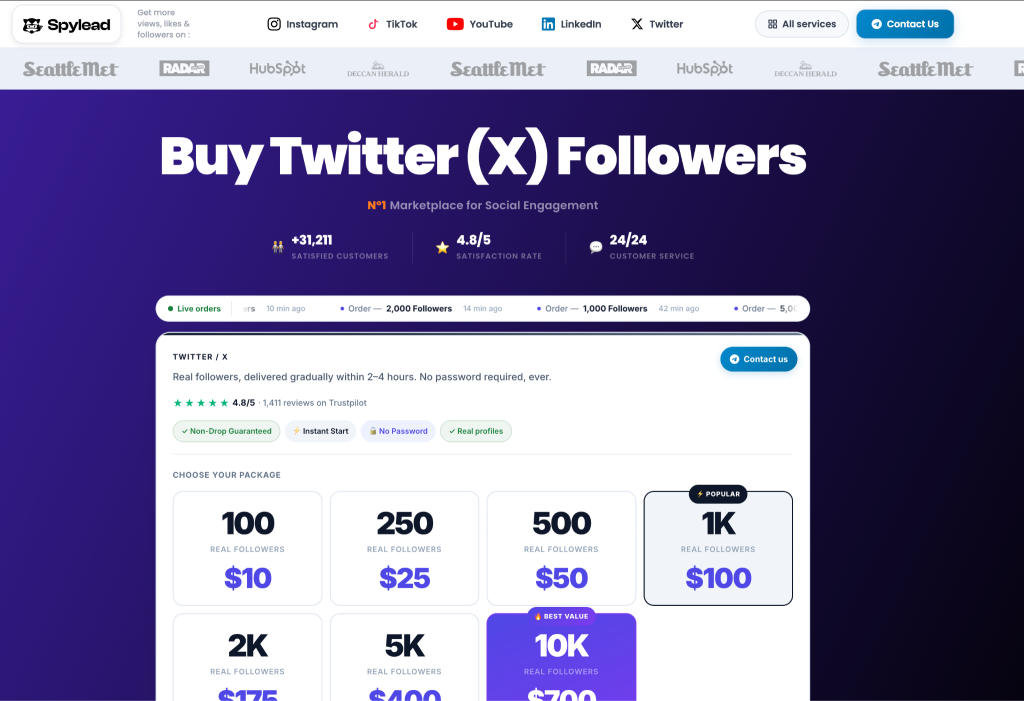
The version that works is buying enough real followers to make your account look credible to the visitors who are already arriving from your website, your sales emails, your case studies, and your founder’s outreach. Those visitors are the ones converting (or not converting) based on what they see. Your follower count is one of the first things they read.
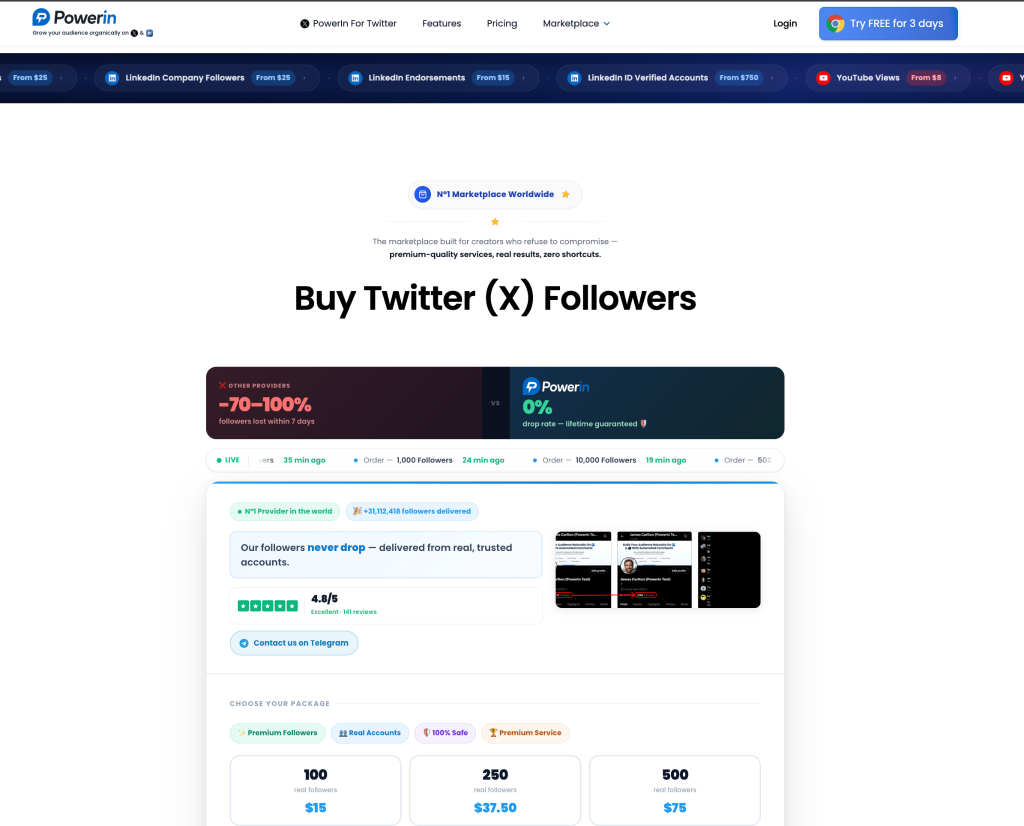
For businesses that want to do this right, PowerIn’s Twitter followers service is the option I would point a marketing team toward first. They deliver real follower accounts, support invoicing for company orders, never ask for account access, and have the operational maturity to handle B2B clients reliably. Spylead is the equally strong alternative, with a lifetime guarantee that some teams will prefer for risk management reasons.
If you want to understand why this works and how to think about ROI properly, the rest of this article is the case.
Why Your Company X Account Matters More Than You Think
Almost every serious B2B sales process now includes a step where a prospect, an investor, a journalist, or a partner Googles your company. Inside that search results page is your X profile. They click it. They look at your follower count. They make a snap judgment.
This is not a hypothesis. There is a body of behavioral research showing that follower counts on social platforms function as social proof signals that influence trust, perceived legitimacy, and downstream actions like clicking, visiting a website, or replying to an email. The mechanism is not complicated. People assume that if a lot of other people follow an account, the account is worth following. Your prospect makes the same assumption about your company without thinking about it.
If your company X account has 200 followers, the silent message it sends is “this company is small, early, possibly inactive.” If it has 8,000 followers, the silent message is “this company is established, has an audience, is part of the conversation.” Same company. Same product. Different first impression.
The cost of that worse first impression is real. It shows up as lower email reply rates, lower meeting acceptance rates, lower demo bookings, and lower close rates on deals where trust is a deciding factor. None of those costs show up on a single line in your CRM, but they aggregate into noticeable revenue over a year.
Buying followers fixes the social proof problem without requiring you to wait years for organic X growth to compound. That is the entire business case.
The ROI Math
Let me work through a realistic example.
Imagine a B2B SaaS company with 2,000 monthly visitors to its website. Of those, roughly 8 percent (160 people) check the company’s X profile during their evaluation. The current X account has 350 followers. A meaningful percentage of those 160 visitors form a “small or early stage” impression, which translates to a small but real reduction in conversion to demo bookings or trial signups.
Suppose the company buys 5,000 real followers from PowerIn or Spylead at a one time cost of around $400. The X profile now shows 5,350 followers. The 160 monthly visitors who check the profile now see an established account. The conversion impact is small per visitor but compounds across thousands of visitors over the lifetime of the account.
Even if the conversion improvement is modest (say, 0.5 percentage points across the 160 monthly visitors), that translates to a few extra qualified pipeline conversations per month. For a B2B company where average contract values are in the low thousands, the breakeven on a $400 follower investment is typically inside the first month and most of the value compounds for years.
The same math applies to DTC brands evaluating customer trust signals, agencies pitching new clients, and consulting firms whose buyers research them before responding to outreach. The mechanism is consistent. Better social proof on your X profile leads to incrementally better conversion across every touchpoint where prospects look at your X profile, which is most of them.
Why Most Businesses Do Not Do This
Despite the math, most B2B companies do not buy followers for their company accounts. The reasons fall into three buckets.
The “it feels off” reason. Marketing leaders often have a vague sense that buying followers is somehow not legitimate, even though they do paid social, paid search, retargeting, and dozens of other tactics that are essentially the same idea. Paying to put your brand in front of an audience is the entire marketing playbook. Paying to put a credible follower count on your profile is the same logic applied to a different surface.
The “what if it gets out” reason. Some teams worry about the optics of having bought followers if a journalist or competitor digs into it. The realistic answer is that this is essentially impossible to detect when you buy from a real follower service. There is no public registry. The followers are real accounts. There is no signature in your account history. The “what if it gets out” concern is mostly a theoretical risk that does not materialize in practice.
The “we tried it once and it failed” reason. Plenty of teams have a story about buying followers from a cheap service and watching the followers vanish within weeks. That is not a failure of the strategy. That is a failure of the service they used. The cheap services sell bots that get purged. The real services sell real followers that stick. Once a team understands the difference, the failed past attempt becomes a lesson rather than a verdict on the whole tactic.
If you can get past these three concerns, the math is straightforward. If you cannot, you are leaving a meaningful amount of low effort growth on the table.
What Makes a Service B2B Appropriate
A few criteria matter more for businesses than for individual creators.
Invoice and payment options that work for finance teams. Your accounting team needs to be able to process the purchase without the vendor looking like a shady marketplace. Real follower services like PowerIn and Spylead process through Stripe and provide proper invoices, which means your finance team can categorize the spend like any other marketing expense.
No password requirements. This is non negotiable for any business account. Sharing the company X password with a third party is a security and compliance disaster waiting to happen. Both services I am recommending only require your public profile URL, full stop.
Gradual delivery that mirrors organic growth. A company X account that suddenly gains 10,000 followers in an hour is the exact kind of thing that draws unwanted attention if anyone is monitoring the account. Real services pace delivery over days to weeks. PowerIn’s pacing runs at 100 to 750 followers per day, which is identical to what natural account growth would look like.
Operational maturity. B2B customers need vendors that respond to support requests, honor refill guarantees, and handle bulk orders for agencies or multi account scenarios. PowerIn explicitly supports bulk orders for agencies and brands managing multiple accounts. Spylead does the same with custom pricing for orders above 50,000.
Real follower accounts that survive scrutiny. The followers you receive should look like real X users to anyone who clicks into them. Profile photos, bios, posting histories, normal follower to following ratios. Both PowerIn and Spylead deliver this consistently.
A service that hits all five criteria is appropriate for business use. A service that fails any of them creates risk that businesses specifically cannot afford.
How to Think About Package Size for Business Accounts
The math here is different from creator accounts.
For most B2B businesses, the goal is to have enough followers to look established without looking suspicious. The right number depends on your industry, your company stage, and the follower counts of comparable companies.
Look at five companies that are roughly in your space and at your stage of growth. Note their X follower counts. Your target should be somewhere in the middle of that range, ideally on the upper end. If your peer group sits between 4,000 and 12,000 followers, you want to land somewhere around 8,000.
For company accounts starting under 500 followers, the typical first order is 2,000 to 5,000 followers. For accounts already in the 1,000 to 2,000 range, an order of 3,000 to 5,000 brings you to a credible plateau. For accounts looking to cross a sponsorship or partnership threshold (often 10K), the 5,000 to 10,000 packages get you there with buffer.
What you do not want is to overshoot dramatically. A company with $200,000 in revenue and a 2 person team having 80,000 X followers looks like exactly what it is. The follower count should be ambitious but believable for the company stage.
Stacking Bought Followers With Organic Strategy
For businesses, buying followers works best as a foundation move that supports a real organic strategy on top.
The bought followers do not engage with your tweets. They are credibility infrastructure, not audience. Your job after buying is to actually use the account. Tweet meaningfully about your industry. Engage with prospects, customers, and journalists in your space. Share product updates, case studies, and thought leadership. Reply to relevant conversations.
When you do this on top of a healthy follower count, two things happen. First, every tweet you post starts with more impressions in front of more people, because X distributes content to a percentage of your followers as the initial baseline. Second, every visitor to your profile sees an account that looks established and active, which makes them more likely to follow you, click through to your website, or respond to outreach.
The bought followers do the credibility work. The organic activity does the audience building. They compound, but only if you do both.
Frequently Asked Questions
Will my company account get banned for buying followers?
If you use a service that delivers real followers gradually, no. X’s enforcement targets bot networks and coordinated inauthentic behavior. Real follower services produce neither. Companies have been buying followers from services like PowerIn and Spylead for years without account incidents. The ban risk in this market is essentially the bot risk, and real services do not deliver bots.
Is this something we should disclose to investors or customers?
No more than you would disclose any other marketing tactic. Buying followers is a legal, common practice that does not require disclosure under any standard or regulation I am aware of. The exception would be if your business specifically claims an organic only growth model, in which case the strategy probably does not fit your brand.
Can we buy followers for multiple company accounts at once?
Yes. Both PowerIn and Spylead support bulk orders and agency pricing. If your company manages multiple X accounts (a corporate account, an executive account, a product account), you can run coordinated orders across all of them.
What about buying followers for our executives’ personal X accounts?
This is a common move for early stage companies where the founders are doing thought leadership. Same rules apply, but be especially careful with package sizing. A founder with 50,000 followers and 14 tweets ever looks worse than a founder with 1,500 followers and meaningful content. Match the follower count to actual posting activity.
How do we measure the ROI?
The honest answer is that the ROI is hard to attribute precisely because the impact is downstream and gradual. The right way to think about it is as a low cost foundational investment in account credibility, the same way you would think about a clean website design or a professional logo. You do not measure those with line item ROI either, because they affect every other part of your funnel.
Final Take
Buying Twitter followers for your company account in 2026 is a quietly high ROI move that most B2B teams ignore because the strategy feels weird, even though it is logically equivalent to dozens of other marketing tactics they already use.
The version that works is buying real followers from a service that delivers gradually, supports proper invoicing, and never asks for account access. PowerIn and Spylead are the two services that hit every criterion that matters for business use. PowerIn for teams that want operational maturity and a 30 day refill. Spylead for teams that want the lifetime guarantee for risk management reasons. Either choice gives you a follower count that materially upgrades your account’s first impression for a one time cost most marketing budgets would not even notice.
The companies that figure this out early get a credibility advantage on every prospect, partner, and journalist who ever Googles them. The ones that do not are leaving free social proof in the bag for no good reason. For the cost of a few hundred dollars and the willingness to think about your X profile the same way you think about your website, you upgrade a touchpoint that touches every part of your funnel.
The math has been on the table for years. The companies that act on it tend to keep quiet about it for obvious reasons, but the practice is more widespread in B2B than the official conversation suggests. Now you know what they know.